April 2, 2026
Bird Watching
When people express a desire to be close to nature, they seem to be longing for wilderness. Since true wilderness can be difficult to find, I choose to find nature in my immediate surroundings. This a familiar nature, experienced by spending time outdoors, observing and listening. I am reminded of my childhood: turning over rocks to watch “rollie pollies” (sow bugs) curl up; catching (and releasing) butterflies; finding a four-leaf clover patch; noticing a cardinal in a tree. I was particularly aware of birds, probably influenced by my grandfather when he drew a cardinal on a scrap of wood for me and my brother.
Appreciating and recognizing birds did not mean I had embraced the binocular-wearing, bird book-carrying and list-making that serious bird watching entails. That came later, when, as a sophomore in college, I enrolled in an interterm course, “Mountain and Desert Ecology” in Texas’s Big Bend Park. We hiked in the Chisos Mountains with our bird books and binoculars, learning to identify birds. Although I never got the hang of binoculars (my glasses are the problem), I started numerous “life lists” written in old field guides. A few years ago my husband gave me a bird feeder for Christmas. Now I find myself staring out the kitchen window, distracted by the birds at the feeder. The Merlin app helps me identify birds by sound. I revert to the hand drawn birds in Peterson’s Field Guide to confirm an identity.
The classifying of birds, animals, plants, etc. is a way people make sense of the natural environment. Carl Linnaeus, an 18th century Swedish biologist and physician, developed a system of classification for plants and animals. Birds, for instance, are in the kingdom “animalia,” phylum “chordate” (animals with a backbone) and “Aves” (warm blooded vertebrates). It can be helpful to know that your bird is either a passerine (perching bird), swimmer (duck), long-legged wader (sandpiper), or a bird of prey. You can look at a bird’s size, and its body, wing, bill, and tail shape. Images of bird silhouettes help identify a bird in flight. Ultimately, identifying a bird comes down to field markings. This is where binoculars are helpful. What color is the bird? Does it have wing bars or wing patterns, tail patterns, rump patches or eye stripes? Often, by the time you adjust your binoculars, the bird has flitted away.
House Watching
If you are interested in buildings, classifying houses can be as satisfying as identifying a bird. In the same way that classifying birds helps us make sense of nature, classifying houses helps us make sense of the built environment.
Houses are not birds however! While the male House Sparrow will always have white wing bars, there is nothing to stop a builder or renovator from mixing styles. Thus you may find Victorian trim applied to the fascia of a Craftsman Bungalow. But at least a house does not flit away while you are watching it!
Many books and writings about house styles use the term “house watching.” Favorites of mine include “New Orleans Houses. A House Watchers Guide” by Lloyd Vogt. Another, the handbook-style guide “What Style is it?” published by the Historic American Buildings Survey (HABS) and the National Trust for Historic Preservation, is part of the “Building Watchers Series.”
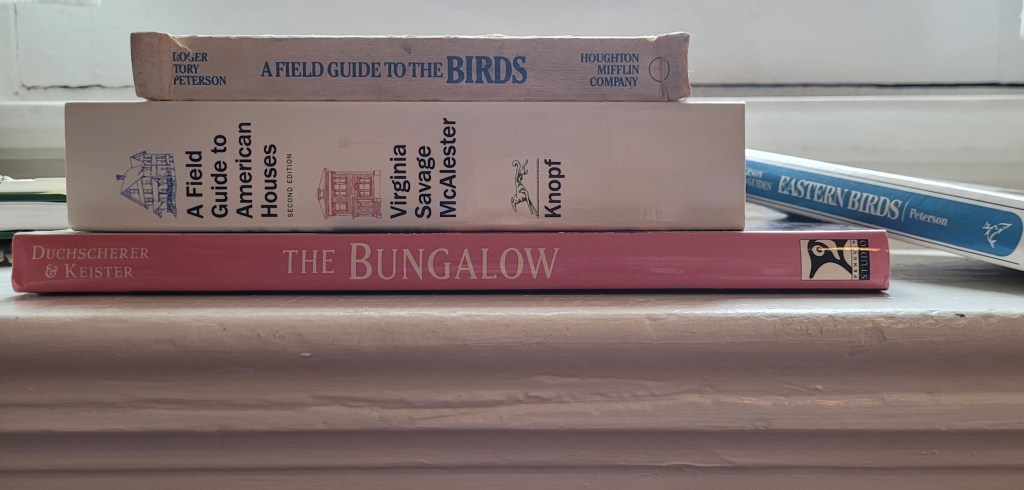
In 1984, Virginia and Lee McAlester published “A Field Guide to American Houses.” I have a 2002 updated copy that is 499 pages long, not counting the “for further reference” section, photo credits and the index. In 2013, Virginia McAlester published an edition that included sections on neighborhood development. She extended her coverage of house types to the 21st Century. My 2022 copy is 848 pages long, including references, acknowledgements and the index. This is truly the definitive resource for house watchers! However, like Roger Tory Peterson’s birding field guides, this book will not fit into a pocket and will certainly weigh down a backpack!
Although I rely heavily on Virginia McAlester for house watching terminology and categorization, I have collected other sources, including the two books listed above and a series of centerfolds from Old House Journal, each addressing a different house style. I also have books and writings on specific house styles such as Prairie or Craftsman style. I will use these books as well as my experience as a “house watcher” to categorize and describe the houses in South Hyde Park.
 Field Guide to South Hyde Park