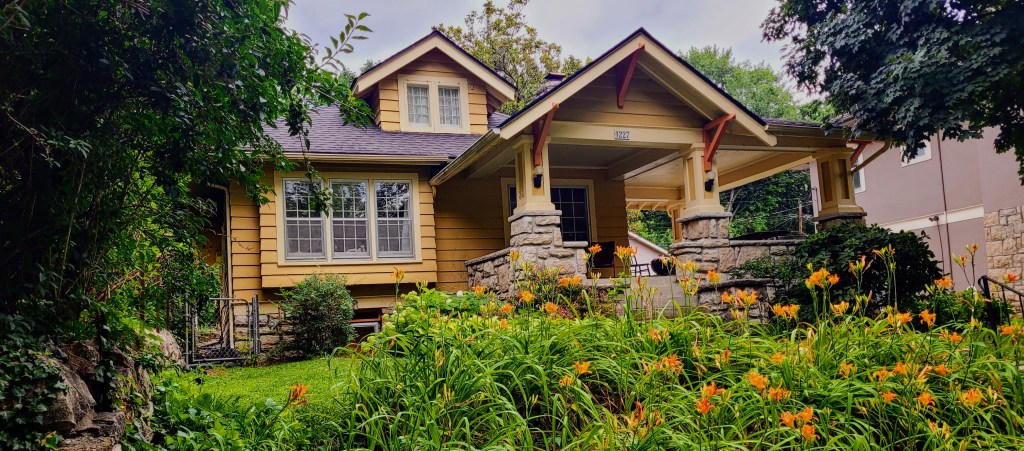
A Good House
My husband and I have lived in our bungalow in South Hyde Park in midtown Kansas City, Missouri since January of 1990. We raised our daughter here and led busy professional and social lives while working on our house. When we bought it, we thought the house was “done” and only needed cosmetic updates. Over thirty years later, there is not an inch of the place that we have not touched. Although many of the changes have been cosmetic, some have been significant, and there is always more to do. John Wheatman, in his book, A Good House is Never Done, wrote “Just because something is already very good, it doesn’t mean it should never change…a good house is never done.” Our house, by this definition is “A Good House”!
Why South Hyde Park?
South Hyde Park is where we live. In the early 2000s, I was among a group of neighbors who successfully worked with Kansas City’s landmarks commission to apply for listing the neighborhood on the National Register of Historic Places. In the application, South Hyde Park was described as “an intact early 20th Century middle class streetcar suburb in Kansas City [that] retains its integrity of location, design materials, feeling and association.” South Hyde Park provides a variety of examples of the types of houses built (mostly) between 1900 and 1930. The main, but not the only, content of this blog will be “house watching,” using South Hyde Park houses as examples of early 20th century residential architecture. My own house will be part of the story. In addition, I will digress, writing about the history of the land that became South Hyde Park, setting that history against the backdrop of the history and development of Kansas City. This history will include subjects such as urban development patterns, the City Beautiful movement, redlining and white flight. The story will continue with hope and optimism for a 21st century renaissance.
 Field Guide to South Hyde Park
Leave a comment