The Best Way to Observe Houses is on Foot
My husband and I are walkers. We chose walking as our form of exercise because we could easily do it together. All you have to do is put on a pair of sturdy shoes, step outside your front door, and go. In addition to almost daily walks in South Hyde Park and other neighborhoods in Kansas City, we always enjoy walking when we travel, both in towns and in rural areas. We like to “strike out” and see where the sidewalk or path takes us.
Over the years, I have combined my interest in house watching with the pleasure of a good walk. This is the best, perhaps the only, way to identify and observe houses. You can pause on the sidewalk and get a good view of the front and sides of a house. Fortunately you don’t need binoculars to observe houses. If someone sees you on the sidewalk peering at their house through binoculars, you may be suspected of nefarious purposes!
How to Use the Field Guide
Whether you live in South Hyde Park, a different Kansas City neighborhood, or in a city, town or rural area in another part of the country, this guide may help you understand and classify your own house. If you simply have an interest in old houses, you can use this guide to help you identify house styles of the early 20th Century whether they are in your own town or city, or in places you visit.
Individual Blog posts will describe each type/style of house in Hyde Park and will include examples and “field markings.”
House Watching Terminology
Type and Style
Lloyd Vogt, the author of New Orleans Houses cites two main characteristics of houses: “Type” and “Style.” A house type is “determined by form and room arrangement. Style is “identified by ornamental embellishments, and by such characteristic building elements as windows and doors.” Virginia McAlester does not differentiate between type and style, but does note that “Style is fashion.” Styled houses “show the influence of shapes, materials detailing or other features that make up an architectural style that was currently in vogue.” Thus a Bungalow is a house type which may or may not incorporate the details and ornament of the Craftsman style. The two most prevalent house types in South Hyde Park are Bungalows and Kansas City Shirtwaists. There are a number of houses in South Hyde Park designed by architects. They can be categorized as a specific type, but they often reflect the style of the architect.
Folk Houses
Folk houses, also called vernacular houses, are usually built by their occupants or by a non-professional builder. They are built as basic shelter. McAlester says: “They are not trying to impress anyone.” The earliest folk houses in the Kansas City area were the log cabins of the early settlers. Some of the oldest houses in South Hyde Park may also be considered folk houses.
The following are the characteristics of a house that help determine its “style” or it’s type of “folk house.”
Form
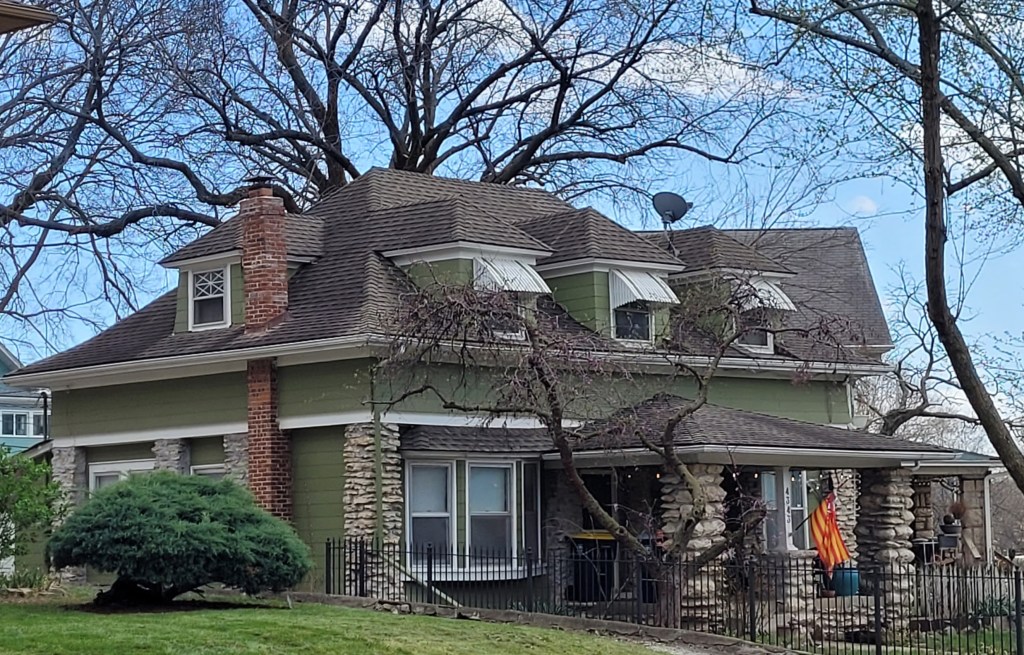
Form is the general shape of the house. The overall shape of a house can be square, rectangular, irregularly shaped, or even round. For example, the classic American Foursquare is, well, square. The form of the roof is also a determining factor: front gable, side gable, hipped or flat. The presence of dormers, which also have a variety of shapes and sizes, contribute to the description of the house. (The house in the photo above has a hipped roof with hipped roof dormers and a hipped roof front porch)
Height
Houses in South Hyde Park range from one to three stories, often with attic or “half story” as the second or third floor. The height of a house is a clue to it’s type. For instance, a bungalow is often defined simply as a house that is one to one-and-a-half stories tall.
Interior Layout
A house watcher standing on the sidewalk will not be able to see the interior layout, although the location of doors and windows may be clues. As each house type is featured in this blog, I will discuss typical interior layouts for that type.
Details
Details are the embellishments that combine to give a house its character. The style of windows and exterior doors, the placement and profile of trim, the brackets or modillions that support eaves, the material and style of porch columns are among the details that contribute to the style of the house.
Other embellishments include bay or oriel windows. Bay windows typically are connected to the ground, and supported by the foundation. Oriel windows project from the exterior wall and may be supported by brackets. Many houses in South Hyde Park have window seats that project from the exterior wall, adding space indoors without expanding the house’s footprint. Sometimes stair landings project from the exterior wall.
Materials
Most houses in South Hyde Park are of wood frame construction sheathed with wood clapboards, wood shingles or stucco. Brick is also used, especially for the walk-up apartment buildings. Limestone is ubiquitous throughout South Hyde Park. It is used for basements, rising up to support exterior walls or form porch walls and porch columns. Many houses are surrounded by low limestone walls. Foundations are a good clue to the age of the house. If the foundation is concrete or concrete block, the house is relatively new. A concrete foundation on part of the house may indicate an addition. The Kansas City Shirtwaist is a house style so common, that this could be called a “Shirtwaist Neighborhood.” Shirtwaist houses have either brick or stone first floors and wood siding or stucco on the upper floors.
Changes Over Time
If the materials are not part of the structure, they are often the components that are likely to have changed over time. Wood siding has seen the most unfortunate changes, with the original siding covered or replaced by the latest “never have to paint again” materials offered each decade or so since the 1950s. Lessons have not been learned. I saw vinyl siding being applied to a house just a few years ago. In the first decade of the 21st century, in an effort to be energy efficient, beautiful old windows were replaced by modern double glazed windows that did not have the character or quality of the original windows.

 Field Guide to South Hyde Park
Leave a comment